

This month we continue with the series, “Practices in Smelling,” which aims to inspire and animate you to engage with your sense of smell more.
I came across a fun article the other day called Stop And Sniff In These Best-Smelling European Cities which ranked 30 European cities according to a kind of “smell index,” based on the number of bakeries, florists, and perfume shops the city had.
That got me thinking about my own town and how smelly it is. Interestingly, according to these measures, it’s pretty smelly, as we have a few perfume shops, several florists, and a number of wonderful bakeries. But honestly, I don’t believe that’s a great way to determine how olfactory-rich a city is.
To me a smell index communicates what the city actually smells like, and how intense the smells are. It’s a mosaic of odors that blend into an olfactory footprint of a city at any given moment in time. The popular name for this impression is SMELLSCAPE.
A smellscape is a collection of odors that you experience in a space you occupy at a particular time. It’s mostly an individual experience because it’s predicated on what you, yourself, smell. But it can be collective as well. My town, for example, has a chocolate factory and many of our streets are lined with eucalyptus trees, so the general smellscape of my town usually has notes of chocolate and eucalyptus wafting in the air at any given time.
Which brings me to today’s practice in smelling. Do you know what your town/city smells like? You probably haven’t thought about it much, which is understandable. But how about we find out!
The benefit of olfactively evaluating a space (your city/town) in time is that you learn something new about a place. You get fresh perspectives because you’re noticing things you hadn’t noticed before. And that gives you greater connection.
Here’s how to do it.
The Architecture
You probably know that a perfume is made up of top, middle, and base notes. Well, in this exercise you’re going to apply the same idea to creating the smellscape of your city/town.
The concept comes from artist and designer Dr. Kate McLean, who has created countless smellscapes of cities around the world. I interviewed her on my podcast about her work, which is fascinating. Listen here.
She explains the making of a smellscape as having three components (like a perfume):
The base notes of a city are the smells that are seemingly always there. They form the backdrop of the olfactory landscape, like canals, lakes, or pastures.
The middle (or heart) notes of a city are the more episodic smells. These are odors that help define a place because on any given day you can smell them. For my town that’s the chocolate and eucalyptus smells. For you it might be a bakery, laundromat, or coffee shop.
The top notes of a city are the unexpected, fleeting smells. These are temporary odors that you notice based on where you are standing. This could be somebody walking by who’s wearing a cologne, or the smell of the warm sun peaking through a cloud at that moment.
Exercise: Create a Smellscape of Your City/Town in a Moment in Time
Time Required: Preferably at least 30 minutes, ideally one hour.
You’ll need a notebook and pen to do this exercise, so that you can take olfactory notes of what you experience.
Depending on how big your town is, you may want to focus on only a section of the city.
Begin by walking ever so slowly, focusing on breathing in naturally, sniffing the air around you.
Look for the base notes first - the smells that fill the background of the space.
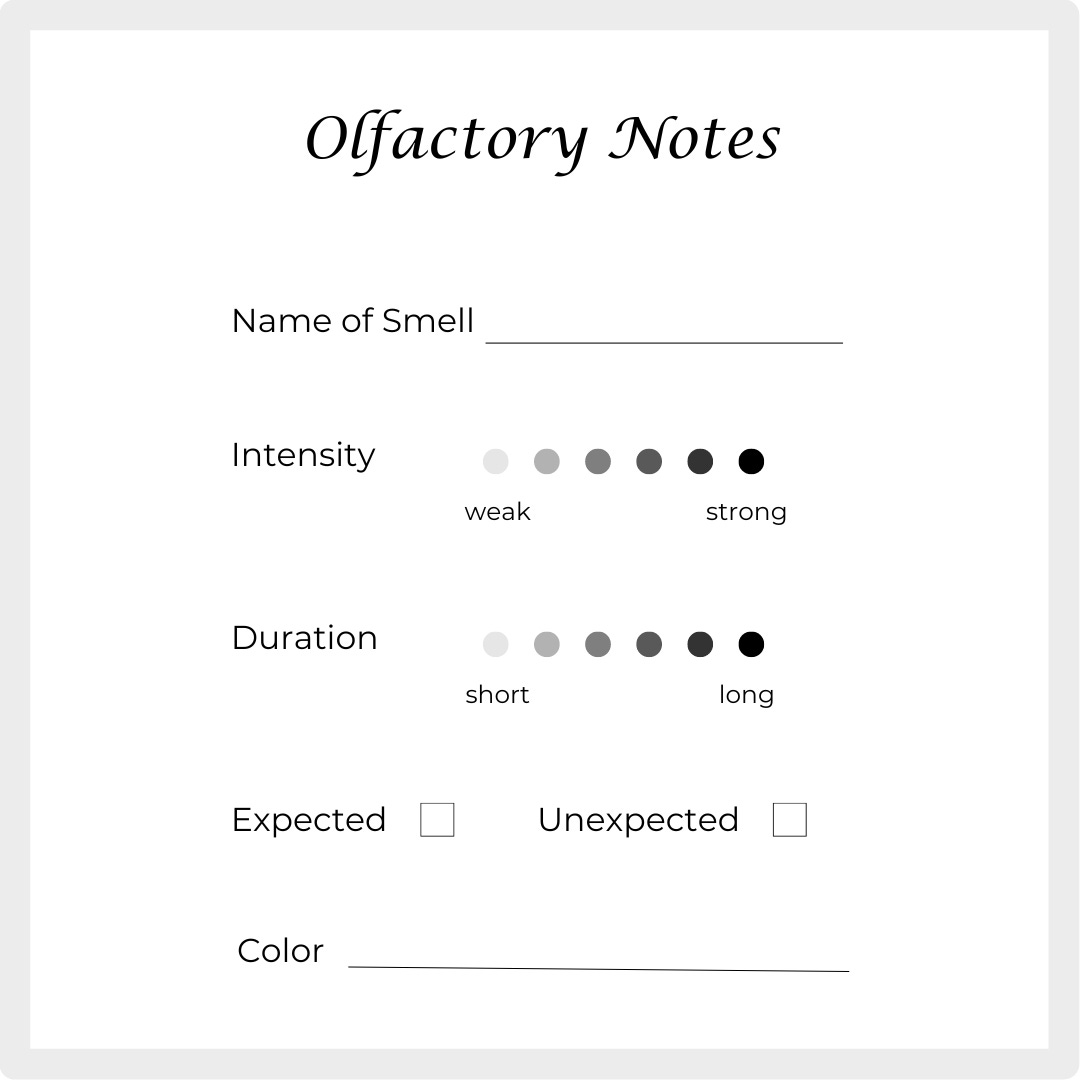
As a distinctive smell appears, write down what you smell - name it as best you can - determine how intense the odor feels, and how long you’re able to smell it. Evaluate whether it was an expected or unexpected smell, and assign the odor a color to match.
Next focus on the middle notes - the smells that make up the core of the space.
Be discerning about what you smell, prioritizing no more than four smells in a span of 10 minutes. Focus on what really “sticks out.”
Lastly, draw your attention to any fleeting top notes that present themselves - the smells that surprisingly pass through the space.
Repeat documenting what you experience, slowly, and gradually recording up to 12 distinct smells in 30 minutes, or 24 distinct smells in 60 minutes.
*Note: smells come and go as they please, so this is only a broad guideline to follow. You might be focused on a middle note, when suddenly a top note appears - grab that top note impression when you can! It’s not a linear exercise, but rather an intuitive one.

When you get back home, why not try making a visual representation of what you experienced. Use your notes and create different colored, and sized, circles of the odors you identified. It’s a wonderful way to map your smellscape.
And that’s the exercise.
I hope you’ll try it out this summer in your town. Explore on different days, in different places and notice how the smells change or remain the same.
Did you discover anything new? Did you gain a greater connection to your town that you didn’t have before?
Let me know how it goes, and feel free to leave a comment. ⬇️
Here’s a curated summer playlist on my podcast An Aromatic Life:
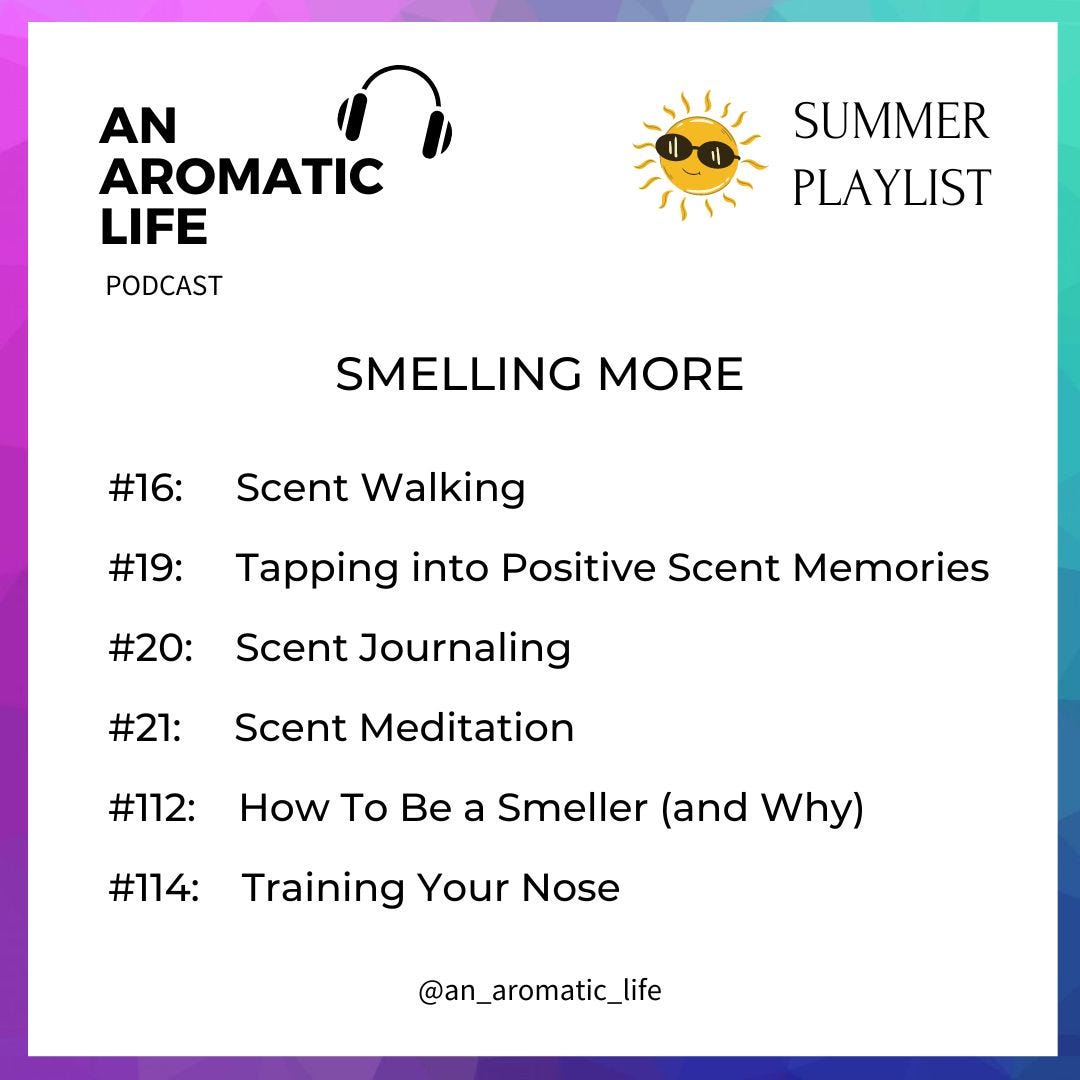
You can listen to these episodes, and many more, on Apple podcast, Spotify, or wherever you get your podcasts. Go here.